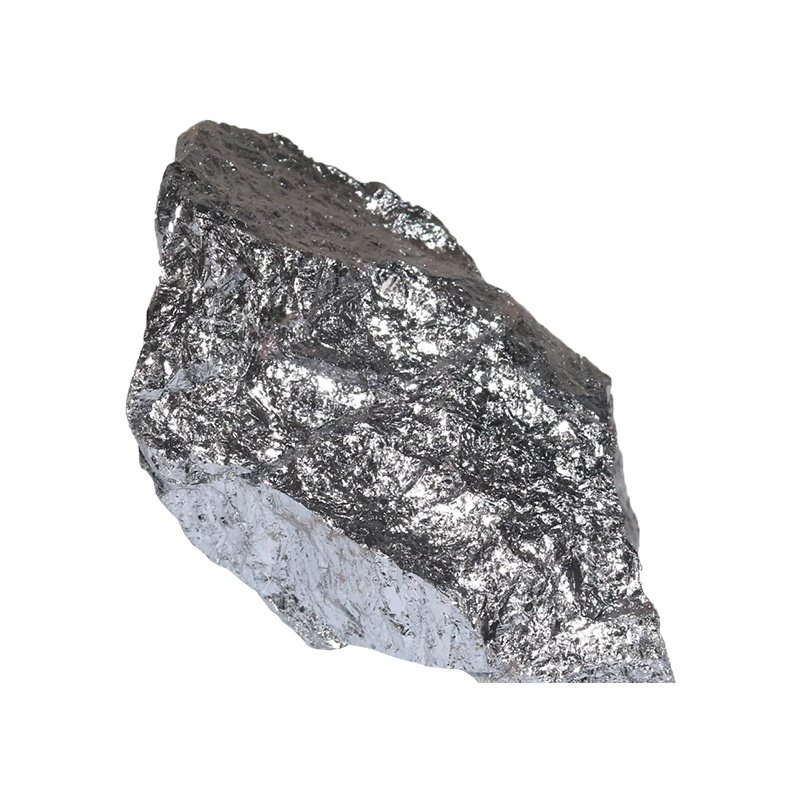
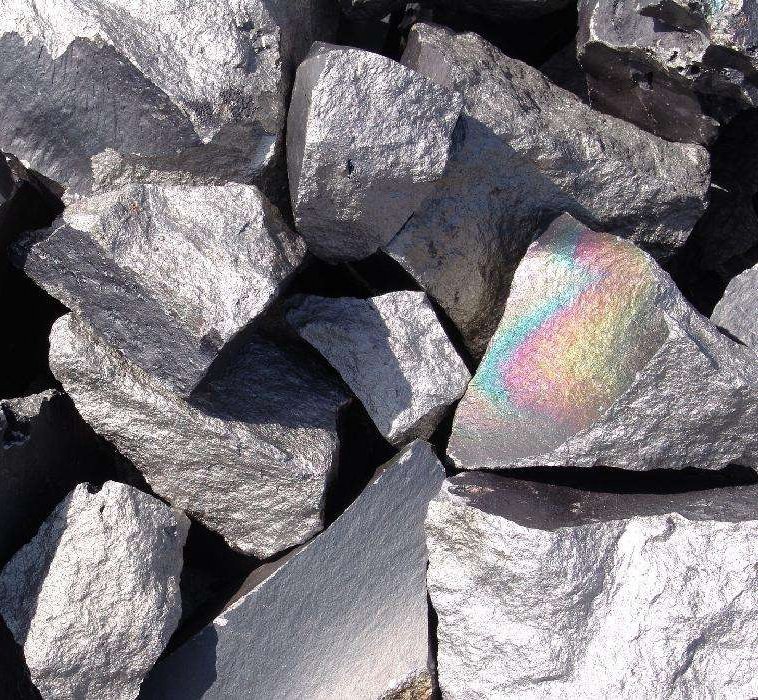
Metallic silicon, also referred to as crystalline silicon or industrial silicon, is primarily utilized as an additive in non-ferrous alloys. This non-metallic element exhibits a gray hue with a metallic sheen and is characterized by its hardness and brittleness. Silicon constitutes approximately 26% of the Earth’s crust by mass. Its properties include a relative atomic mass of 28.8, a density of 2.33 g/cm³, a melting point of 1410°C, a boiling point of 2355°C, and a resistivity of 21400 Ω·m.
Silicon metal alloy
Silicon metal powder
Silicon metal sample
Silicon metal lumps
Classification of Metallic Silicon:
Based on the content of iron, aluminum, and calcium, metallic silicon is categorized into various grades, including 553, 441, 421, 3303, 2202, and 1101. These grades find extensive application across different industrial sectors.
By-products of Metallic Silicon:
The production of metallic silicon generates several by-products:
Silica fume (also known as micro-silica or silica dust), which is widely employed in the refractory and concrete industries.
Edge silicon and black silicon, which are waste materials generated during manufacturing.
Silicon slag, a residue from silicon smelting that holds specific industrial applications.
Production Process of Metallic Silicon:
Metallic silicon is typically produced in an electric furnace through the reduction of silicon dioxide (SiO₂) using carbon, according to the following chemical reaction:
SiO₂ + 2C → Si + 2CO
The silicon obtained through this method has a purity of 97-98% and is commonly referred to as industrial silicon. By remelting and recrystallizing it, followed by acid treatment to remove impurities, the purity can be increased to 99.7-99.8%.
Allotropic Forms of Metallic Silicon:
Amorphous Silicon: This form appears as a gray-black powder and is technically a type of microcrystal. It exhibits high chemical reactivity, burning vigorously in oxygen and reacting with non-metals such as halogens, nitrogen, and carbon at elevated temperatures. It also reacts with metals like magnesium, calcium, and iron to form silicides. Amorphous silicon is insoluble in acids but can dissolve in a mixture of nitric acid and hydrofluoric acid.
Crystalline Silicon: Crystalline silicon possesses a diamond-like structure with semiconductor properties. It has a melting point of 1410°C, a boiling point of 2355°C, and a Mohs hardness of 7. Chemically inert, it does not oxidize at high temperatures. Like its amorphous counterpart, crystalline silicon dissolves in a mixture of nitric and hydrofluoric acids.
Major Industrial Applications of Metallic Silicon:
Production of Organosilicon Compounds:
Silicone rubber: Valued for its excellent elasticity and heat resistance, it is used in medical devices and high-temperature gaskets.
Silicone resin: Primarily utilized in manufacturing insulating varnishes and high-temperature coatings.
Silicone oil: A high-grade lubricant and polishing material, silicone oil is also employed in fluid springs and dielectric fluids. It can be processed into a transparent, colorless liquid for use as a waterproofing agent on building surfaces.
Manufacture of High-Purity Semiconductors:
High-purity metallic silicon is essential for producing modern large-scale integrated circuits. It also serves as a key raw material for manufacturing optical fibers, positioning metallic silicon as a foundational material for the information technology industry.
Alloy Formulation:
Silicon-Aluminum Alloy: Widely used as a deoxidizer in steelmaking, this alloy enhances deoxidation efficiency and purifies molten steel, thereby improving steel quality. Its lightweight nature, low thermal expansion coefficient, and excellent casting properties make it ideal for aerospace and automotive components.
Silicon-Copper Alloy: Known for superior welding properties and resistance to sparking upon impact, silicon-copper alloys are used to manufacture explosion-proof storage tanks.
Silicon Steel Sheets: Adding silicon to steel improves its magnetic properties by reducing hysteresis and eddy current losses. These sheets are critical in manufacturing transformer and motor cores, enhancing the performance of electrical equipment.
Metallic silicon plays an indispensable role in numerous industries, ranging from the production of organosilicon compounds and high-purity semiconductor materials to the formulation of specialized alloys. As a foundational material, its applications span key sectors such as information technology, aerospace, and energy equipment, offering significant potential for future development.
Beifang Alloy offers a comprehensive range of industrial silicon products across various grades. They provide silicon metal powder in different categories and particle sizes, and support customization of silicon metal blocks, particles, and powder products to meet specific customer requirements.