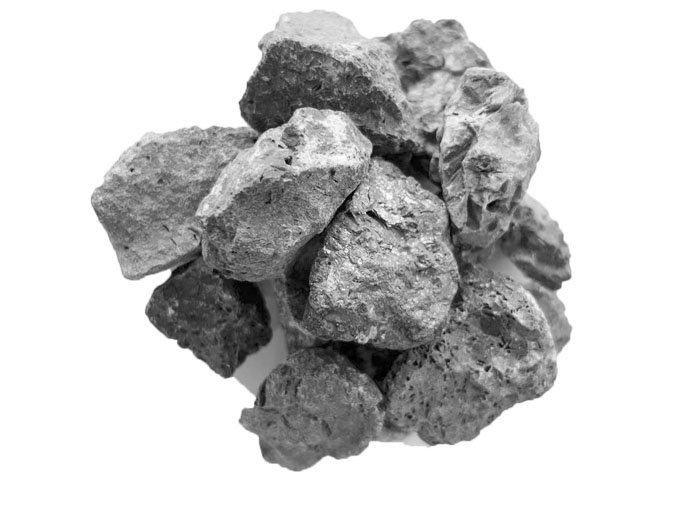
In the continuous casting process, two problems consistently plague production managers: nozzle clogging and stringent inclusion control. These issues don’t just damage equipment; they kill yield rates and downgrade final product quality.
As steel grades become more demanding (high strength, low temperature toughness, and deep drawing performance), the need for precise deoxidation has never been greater. Enter the Silicon-Aluminum-Calcium (Si-Al-Ca) Deoxidizer—a composite alloy designed not just to remove oxygen, but to modify inclusions.
At Beifang Alloy, we have spent decades refining the metallurgy of these complex compounds to ensure your steel flows cleanly and solidifies soundly.
To understand why Si-Al-Ca is non-negotiable in modern steelmaking, we must first diagnose the diseases it cures.
When aluminum is used alone as a deoxidizer, it forms Al₂O₃ (alumina). These inclusions are hard, angular, and have a high melting point (>2050°C). During continuous casting, they adhere to the walls of the submerged entry nozzle (SEN). This buildup restricts flow, alters steel levels in the mold, and forces costly nozzle changes or “burning” operations.
Even if the nozzle doesn’t clog, unmodified Al₂O₃ clusters act as stress concentrators in the final rolled product. This leads to:
Lamination in sheets.
Pinholes in wire rods.
Fatigue failure in automotive parts.
The Business Case: A 10% reduction in nozzle clogging events translates to a 3-5% increase in productivity and a significant drop in rejected coils.
Why does Silicon-Aluminum-Calcium work where standard alloys fail? The answer lies in phase transformation.
Aluminum (Al): Lowers the oxygen content aggressively.
Silicon (Si): Provides secondary deoxidation and strengthens the steel matrix.
Calcium (Ca): The “Modifier.” It reacts with the solid Al₂O₃ to form a complex Calcium Aluminate (e.g., 12CaO·7Al₂O₃) .
Pure Al₂O₃ melts at ~2050°C. However, the Calcium Aluminate compound formed by Si-Al-Ca has a melting point of approximately 1400°C–1500°C.
Result: At casting temperatures (approx. 1550°C), these inclusions are liquid droplets.
Benefit: They remain spherical and fluid, remaining suspended in the slag layer rather than sticking to the ceramic nozzle walls. They easily float out of the steel, improving cleanliness.
Research in 2025-2026 indicates that the ratio of Si:Al:Ca is critical. An excess of Ca leads to refractory erosion; a lack of Ca results in semi-solid inclusions. The optimal range for high-grade steel (such as pipeline or automotive steel) is increasingly pointing toward low-silicon, high-aluminum, balanced-calcium formulations—exactly where Beifang Alloy’s R&D excels.
Selecting a deoxidizer isn’t just about chemistry; it’s about physical form and consistency. Here is our guide to making the right purchase.
Ca Content: Aim for 8%-12% for standard grades, but consider higher Ca (14%+) for severe clogging issues.
Al/Ca Ratio: A ratio between 2.0 and 3.0 is generally ideal for maintaining fluidity without attacking the tundish lining.
Impurities (P, S): Ensure these are strictly controlled (<0.05%). High sulfur negates the beneficial effects of calcium by forming CaS, which also causes clogging.
Size & Granularity: For cored wire, consistency in powder size (0-2mm) ensures stable feeding speeds and uniform dissolution.
Density: A dense alloy penetrates the molten steel bath better. Avoid porous materials that float on the slag.
Given the hygroscopic nature of calcium compounds, moisture is the enemy. Always verify that the supplier uses:
Waterproof, sealed inner bags.
VCI (Vapor Corrosion Inhibitor) paper to prevent oxidation during shipping.
Clear labeling of Lot # for full traceability.
The market is flooded with traders and small-scale mixers. Here is why metallurgical engineers consistently rank Beifang Alloy as their preferred partner.
| Criteria | Beifang Alloy | Typical Competitors |
|---|---|---|
| Raw Material Sourcing | Vertical Integration: Direct control over high-purity aluminum and silicon sources. | Often use recycled or off-spec materials, leading to variable recovery rates. |
| Metallurgical Control | Precision: Strict tolerance control (e.g., Ca fluctuation < ±1%). Dedicated lab for inclusion analysis. | Tolerance ranges are often wide (±3-5%), leading to inconsistent steel quality. |
| Physical Form | Customizable: Offers both standard grain sizes and specialized cored wire filling for premium grades. | Usually “one-size-fits-all” with high powder degradation. |
| Technical Support | On-site Steel Mill Trials: We don’t just sell; we provide ladle injection parameters and slag optimization advice. | Sales-focused; limited metallurgical expertise. |
| Global Logistics | ISO 9001 Certified: Expedited shipping via Tianjin/Qingdao ports with robust anti-moisture packaging. | Often reliant on third-party logistics, risking moisture damage. |
The battle against inclusions and nozzle clogging is a fight for value. By switching to a high-performance Silicon-Aluminum-Calcium Deoxidizer, you not only improve castability but also unlock the potential for higher-grade steel premiums.
At Beifang Alloy, we don’t just produce ferroalloys; we provide process stability. Whether you are running a BOF, EAF, or LF refining station, our alloys are engineered to deliver the precise calcium activity needed to turn brittle alumina into fluid, harmless droplets.
Ready to optimize your steelmaking process?
Visit: www.beifangalloy.com
Email: info@hnxyie.com