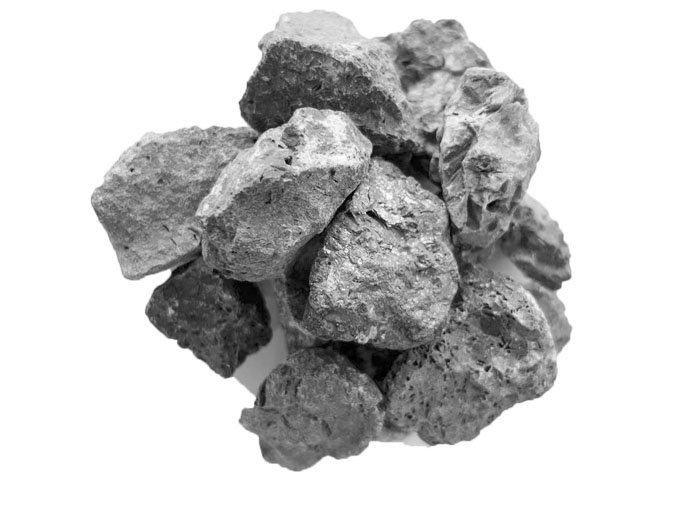
In the converter steelmaking process, deoxidation is a critical step that determines molten steel quality and final product performance. At the end of converter blowing, molten steel contains excessive dissolved oxygen [O]. If deoxidation is incomplete, this oxygen reacts with carbon during solidification, generating CO gas that compromises steel density and leads to defects such as porosity, honeycombing, and even bulging. Meanwhile, precipitated oxygen reacts with elements like silicon, manganese, and aluminum to form non-metallic inclusions — a primary cause of hairline cracks in high-grade steels. For low-carbon, low-silicon steel grades, deoxidation and inclusion morphology control are particularly challenging; poor deoxidation directly results in subsurface blowholes in cast slabs or nozzle clogging during continuous casting.
So, can silicon-aluminum-calcium (Si-Al-Ca) deoxidizer solve this problem? The answer is yes. As a composite deoxidizer, Si-Al-Ca is specifically designed to overcome the limitations of traditional single-element deoxidizers (such as pure aluminum).
From an industry pain-point perspective, the core requirements for deoxidizers in converter steelmaking are:
| Requirement | Description |
|---|---|
| Deep deoxidation | Reducing end-point oxygen content is the root cause of inclusion reduction. Research shows that to improve surface quality of cold-rolled sheets, deoxidation inclusions must be minimized — starting with lower converter end-point oxygen levels. |
| Improved melt fluidity | Traditional aluminum deoxidation generates high-melting Al₂O₃ inclusions, which tend to cause tundish nozzle clogging, disrupting production continuity. |
| Steel purification & inclusion reduction | Deoxidation products should be easy to float and remove, thereby purifying the melt. |
| Cost control | Reducing per-ton consumable costs while maintaining deoxidation performance is a key procurement metric for steel mills. |
The reason Si-Al-Ca deoxidizer effectively eliminates the hazard of incomplete deoxidation lies in its unique mechanism:
Silicon, aluminum, and calcium work together to combine with free oxygen in the melt at different energy levels, achieving gradient deoxidation — far more thorough than single-element deoxidizers. Aluminum acts as the strong deoxidizer, silicon as the auxiliary, while calcium plays the critical modifying role.
This is the core advantage of Si-Al-Ca. Calcium transforms high-melting, brittle Al₂O₃ inclusions into low-melting, liquid calcium aluminates (e.g., mCaO·nAl₂O₃). These composite deoxidation products readily coalesce, grow, and float out of the molten steel. This mechanism fundamentally resolves tundish nozzle blockage while simultaneously reducing inclusion content and enhancing final steel quality.
Calcium also reacts with sulfur to form stable CaS, eliminating the risk of hot shortness (hot brittleness) in steel and improving toughness and fatigue resistance.
Si-Al-Ca deoxidizer also promotes rapid slag formation, provides excellent arc-submerging effects, and exhibits strong inclusion-absorbing capacity — effectively shortening smelting time, reducing power consumption, and extending refractory service life.
When sourcing Si-Al-Ca deoxidizer, focus on the following key dimensions:
Chemical composition: Specifications vary by steel grade requirements. Common reference ranges include Al ≥ 9–16%, Ca ≥ 15–16%, Si ≥ 30–38%. Calcium content is particularly critical, as it directly determines inclusion modification effectiveness.
Physical properties: Pay attention to particle size (typically 10–60 mm), moisture content (H₂O ≤ 0.5%), etc., to ensure rapid melting and reaction upon addition to the ladle.
In-house production capacity: Prioritize manufacturers with their own production facilities over pure trading companies. In-house producers offer better quality control and cost stability.
Quality management: Verify ISO 9001 or equivalent certifications. Ensure the supplier has robust testing capabilities to guarantee consistent composition and minimal batch-to-batch variation.
Location and logistics: Anyang (Henan) is a major ferroalloy industrial cluster, strategically located in China’s metallurgical heartland. Local suppliers benefit from easy raw material access and nationwide logistics coverage, offering inherent cost and delivery advantages.
Customization capability: Can the supplier adjust product formulations and particle sizes based on your specific steel grades and smelting processes? This flexibility is a hallmark of excellent suppliers.
Technical support: Does the supplier provide on-site technical guidance to optimize deoxidizer addition protocols and troubleshoot application issues?
Supply stability: Assess the manufacturer’s production capacity and inventory levels — can they guarantee long-term, uninterrupted supply to avoid production stoppages?
From an industry supply landscape perspective, the Anyang region in Henan has developed a mature ferroalloy industrial cluster, hosting multiple competitive manufacturers of Si-Al-Ca and other composite deoxidizers. When comparing suppliers, consider these dimensions:
| Comparison Factor | What to Look For |
|---|---|
| Production scale | Larger manufacturers (e.g., factory areas exceeding several thousand sq.m., annual sales in the tens of millions RMB) are better equipped to handle bulk orders. |
| Technology & formulation | Some suppliers have deep expertise in composite deoxidizer formulations (Si-Al-Ca, Si-Al-Ba-Ca, etc.), delivering superior synergistic deoxidation performance. |
| Service model flexibility | Preferred suppliers support flexible cooperation models — long-term framework agreements, on-demand production scheduling, trial samples, etc. — to accommodate diverse customer purchasing rhythms. |
| Overall cost-effectiveness | Leveraging centralized raw material procurement and logistics advantages, Anyang-based manufacturers often offer stronger price competitiveness at comparable quality levels. Market data suggests Si-Al-Ca deoxidizer prices typically range around RMB 1,000–1,200/ton. |
As a key player within the Anyang ferroalloy industrial belt, Beifang Alloy has long been dedicated to providing high-quality Si-Al-Ca and other composite deoxidizer solutions to steel mill customers. Our competitive strengths include:
Integrated production, assured quality: Full-process control from raw material screening to finished product dispatch ensures uniform chemical composition and consistent deoxidation performance.
Logistics advantage, rapid delivery: Located at the heart of Anyang’s metallurgical cluster, our distribution network covers the entire country, ensuring timely fulfillment of your orders.
Flexible service, tailored solutions: We adjust product specifications based on your steel grades and process requirements, providing one-on-one technical support to match your unique needs.
Choose Beifang Alloy — Choose Stable, Reliable Deoxidation Solutions.
Contact Us:
Website: www.beifangalloy.com
Email: info@hnxyie.com
For every heat of steel, purer. For every ton of steel, better.