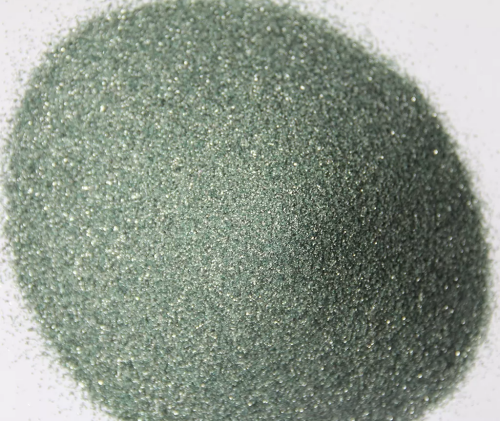
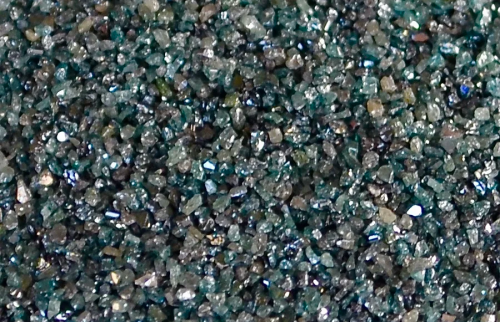
When a procurement manager receives a quotation for green silicon carbide, the headline number is almost always the same: “SiC ≥ 98%” or “SiC ≥ 99%.” What that quotation frequently omits is the information that actually determines whether the material will perform in your furnace, your refractory mix, or your customer’s grinding wheel. That information is the impurity profile.
For ferroalloy plants and refractory manufacturers, the typical impurity specifications of green silicon carbide are not a single fixed set of numbers. They vary significantly by grit size, application grade, and supplier. Understanding this variation—and knowing how to verify it—is essential for making a procurement decision that protects both your process and your margin.
1. Procurement Needs: Define Your Impurity Limits Before You Ask for a Quote
The first mistake in sourcing green silicon carbide is asking a supplier for their “best purity.” The second is accepting a certificate of analysis (COA) that lists only SiC content. A complete impurity specification for green silicon carbide typically includes four parameters: free carbon (F.C), iron oxide (Fe₂O₃), free silicon (F.Si), and moisture. For some applications, free silica (SiO₂) and magnetic material content also matter.
What “Typical” Actually Means
Published technical data from reputable producers illustrates the range. Fiven’s abrasive-grade green silicon carbide macro grains typically show SiC at 98.90%, free carbon at 0.15%, free SiO₂ at 0.40%, and free silicon at 0.40% . Their high-purity SIKA ABR I grade pushes SiC to 99.60% with free carbon at 0.15% and free silicon at 0.10% . Chinese-produced green silicon carbide micro powders, by comparison, often list SiC ≥ 98% with Fe₂O₃ ≤ 0.15% and free carbon ≤ 0.15% for general grades, while finer grits may see Fe₂O₃ rise to 0.30% or higher as classification becomes more challenging .
For ferroalloy and metallurgical applications, the priority differs from abrasive applications. Green silicon carbide used as a deoxidizer or alloy additive may tolerate a lower SiC content, but free carbon and iron must be tightly controlled to avoid introducing unwanted elements into the melt. A supplier who quotes “99% purity” without specifying free carbon and iron oxide is providing an incomplete specification .
A Practical Specification Template
Before requesting quotations, document your minimum acceptable limits. A reasonable starting framework for industrial-grade green silicon carbide looks like this:
| Parameter | General Refractory / Metallurgical Grade | Precision Abrasive Grade |
|---|---|---|
| SiC content | ≥ 97.5–98.5% | ≥ 98.5–99.5% |
| Free Carbon (F.C) | ≤ 0.30% | ≤ 0.15–0.20% |
| Fe₂O₃ | ≤ 0.30–0.50% | ≤ 0.10–0.15% |
| Free Silicon (F.Si) | ≤ 0.40% | ≤ 0.10–0.15% |
| Moisture | ≤ 0.10% | ≤ 0.05% |
These ranges are synthesized from published supplier data and industry guidance . Your specific furnace lining or refractory formulation may demand tighter limits on iron, while a bonded abrasive application may prioritize free carbon control. The key is to specify these limits in your inquiry rather than accepting whatever the supplier’s standard COA happens to show.
2. Industry Research: Why Impurity Specifications Diverge
The impurity profile of green silicon carbide is not arbitrary. It reflects the smelting process, the raw material quality, and—critically—the sizing and classification steps that follow.
The Smelting Legacy
Green silicon carbide is produced in electric resistance furnaces from quartz sand, petroleum coke, and salt. The green color comes from the absence of certain impurities that would otherwise darken the crystal. But “green” does not mean “pure.” Industrial green silicon carbide typically contains free silicon from incomplete reaction, free carbon from excess coke, and iron from the raw materials and furnace hardware . A typical chemical comparison shows green silicon carbide with SiC around 98.80%, free silicon at 0.59%, free carbon at 0.03%, and combined Fe + Al at 0.17% .
Grit Size Changes the Specification
One of the most important facts for procurement is that impurity specifications are grit-dependent. Coarse grits are easier to classify and generally carry lower iron contamination. As grit size decreases, the surface area increases, and the opportunity for contamination during crushing, milling, and classification rises.
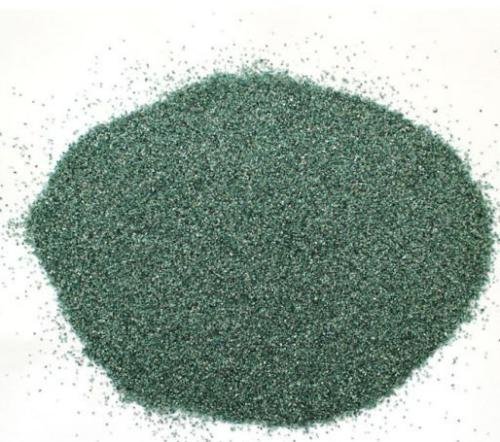
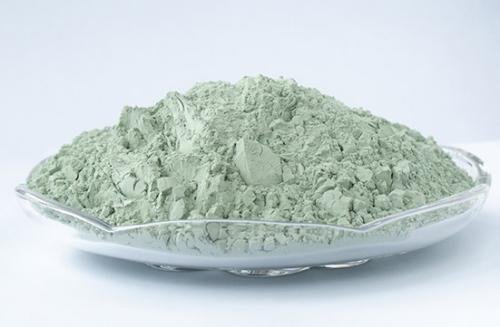
Chinese product data illustrates this clearly. A general-purpose green silicon carbide specification lists Fe₂O₃ ≤ 0.15% and free carbon ≤ 0.15% for the base product. But the detailed grit table shows that while #240 grit may hold Fe₂O₃ ≤ 0.3%, the specification for #4000 grit allows Fe₂O₃ up to 1.00% and SiC as low as 94.00% . This is not a defect; it is a reflection of the physics of fine powder production. The procurement implication is direct: if you need FEPA F1200 material with iron below 0.15%, you must specify it explicitly, because the “standard” grade may not meet that limit.
The FEPA vs. JIS Distinction
Grain size standards are not interchangeable, and this affects how impurity specifications are reported. FEPA F240 corresponds to a D50 of approximately 44.5 μm. JIS #240 is defined differently, and the distribution curve may not match . A supplier who states “F240, Fe₂O₃ ≤ 0.3%” without confirming the standard is leaving room for a material that passes their internal sieve but fails your process validation. For export orders, specify the standard explicitly: FEPA F-series, JIS R6001, or GB/T 2481.
 |
 |
3. Procurement Guide: How to Verify Impurity Claims
A COA is a starting point, not a guarantee. The following steps will help you move from a supplier’s claim to a verifiable specification.
Request guaranteed minimums, not “typical” values. Many COAs report a “typical” SiC content of 99% while the guaranteed minimum may be 97%. For production planning, the guaranteed minimum is the number that matters .
Ask for the testing method. A credible COA should state whether SiC content was determined by chemical titration or by difference (subtracting impurities from 100%). The latter method can inflate the apparent SiC content if impurity measurements are incomplete. For iron, ask whether the value was obtained by atomic absorption spectrometry (AAS) or ICP-OES .
Request three consecutive batch COAs. A single favorable COA does not represent ongoing supply. Batch-to-batch variation in free carbon and iron is common, particularly in smaller producers. Three consecutive batches give a more realistic picture of consistency .
Specify particle size distribution, not just grit number. Two powders labeled F240 can both have a D50 near 44.5 μm but differ in the tails of the distribution. For refractory applications where fines affect flow and compaction, or for abrasive applications where coarse particles cause scratches, the full distribution curve matters as much as the impurity profile .
Consider third-party verification for critical applications. If the green silicon carbide is destined for a high-value refractory lining or a semiconductor-adjacent ceramic application, the cost of an independent laboratory analysis is small relative to the cost of a failed batch. SGS, Bureau Veritas, and Intertek all offer chemical analysis services for abrasive materials.
4. Supplier Comparison: What to Look For Beyond the Price Sheet
The global green silicon carbide supply landscape is dominated by Chinese producers, who account for an estimated 55% of global output . But within China, supplier capabilities vary widely, and the lowest price per ton is rarely the lowest cost of ownership.
Questions to Ask Each Supplier
“What is your guaranteed maximum Fe₂O₃ for the specific grit I am ordering?” A supplier who answers with a range (“0.1 to 0.3% depending on grit”) is more credible than one who claims a single low number for all sizes. The grit-dependent nature of iron contamination is a fact of production; a supplier who acknowledges it understands their process.
“Can you provide a COA for the exact lot I will receive?” Pre-shipment COAs tied to the specific lot number are standard practice among reputable exporters. A COA from a previous month’s production is not sufficient.
“What is your capacity for the grit size I need, and what is your lead time?” Green silicon carbide production is energy-intensive and subject to periodic power restrictions in major producing regions. A supplier who cannot provide realistic lead times may be sourcing from third parties, which introduces another layer of quality uncertainty.
“Do you offer surface-treated or coated grades?” For some refractory and ceramic applications, surface treatment (such as silane coupling agents) can improve dispersion and reduce moisture pickup. Not all suppliers offer this, and it may not be necessary for your application, but the question reveals whether the supplier serves the refractory market or only the abrasive market.
Red Flags in Supplier Claims
A COA that lists only SiC content and no impurity values is incomplete. A “typical” value with no guaranteed minimum is unverifiable. A price significantly below the market range for the stated specification—without a credible explanation such as off-grade material or a clearance lot—warrants scrutiny. And a supplier who cannot name the standard (FEPA, JIS, GB) their grit designation follows is not a supplier you want to rely on for process-critical material.
A Note on Price Context
For reference, Chinese export prices for green silicon carbide (98% min, FEPA grit sizes) have shown significant volatility, with FOB China indications in the range of USD 4,000–4,600 per metric ton for abrasive-grade material in late 2026 . Metallurgical-grade green silicon carbide in coarse lump form has traded at substantially lower levels, reflecting the different specification and end-use . Price differences between suppliers should always be evaluated against the specific impurity limits and grit size you require, not against a headline grade.
The typical impurity specification for green silicon carbide is not a single answer. It is a function of grit size, application grade, and the supplier’s process control. For ferroalloy and refractory buyers, the productive approach is to define your own impurity limits first, then require suppliers to meet them with guaranteed values and lot-specific COAs. The difference between 0.15% and 0.30% Fe₂O₃ may not appear in a headline price, but it can appear in your furnace lining life, your refractory’s hot strength, or your customer’s rejection rate.
Beifang Alloy supplies ferroalloy and refractory raw materials to steel mills, foundries, and refractory manufacturers worldwide. For inquiries about green silicon carbide specifications, pricing, or technical documentation, contact us at info@hnxyie.com or visit www.beifangalloy.com.