In the daily operation of ferroalloy and metallurgical furnaces, localized lining damage is one of the most common causes of unplanned shutdowns. Faced with a ring of erosion along the slag line, a spalled patch on the furnace wall, or a scoured hollow in the corner of a ladle bottom, maintenance teams face a decision that looks simple but carries long-term consequences: do we tear out that small section of brick and re-lay it, or do we simply patch it with castable?
Choose wrong, and the patch may spall off quickly, forcing a second shutdown—or worse, the repair material may bond poorly with the existing brickwork and create a new leakage path during operation. Choose right, and you can extend lining life by dozens of heats at a fraction of the cost of a full reline.
This article approaches the decision from a procurement and maintenance perspective, covering four dimensions: defining the actual need, understanding the industry mechanics, a practical procurement guide, and supplier comparison.
Before deciding between brick and castable, two questions must be answered: What is the location and form of the damage? What is the root cause?
Judging by damage form and severity. Industry practice draws a fairly clear boundary between the two approaches. Local brick replacement (known as “dig-and-patch”) is appropriate for areas with deep erosion, compromised structural integrity, or large damaged zones—it is costly and time-consuming. Castable repair, by contrast, suits moderate or uniform/irregular erosion, offering fast execution and lower overall cost. Take an iron ladle bottom: if the damage is not severe, localized castable repair is a feasible and rapid solution. Only when the bottom has been punched into a deep pit by scrap steel—destabilizing the structure—is dig-and-patch brick replacement necessary.
Judging by location. Different lining zones experience fundamentally different wear mechanisms. In smelting reduction furnaces, when slag-line erosion reaches ≥200mm and the tap-hole block shows abnormal wear, a chrome-corundum self-flowing castable “ring sleeve” repair can be applied without removing the entire inner lining—shortening the construction cycle while preserving the permanent layer. This shows that even in high-wear zones like the slag line, castable repair is viable under specific conditions; the key question is whether erosion has already threatened structural safety.
Starting point for procurement decisions: Before finalizing any repair plan, require technical staff to document the damage location, area and depth, and whether the original brickwork structure remains intact. These three data points drive everything that follows.
 |
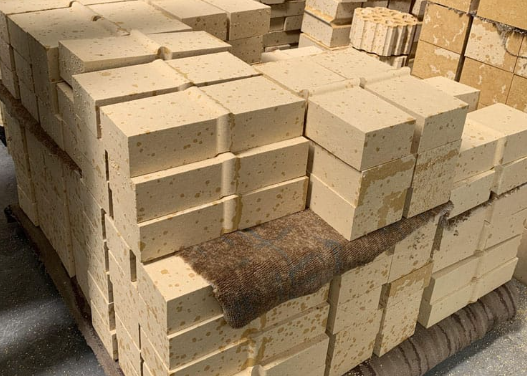 |
The core value of brick replacement (dig-and-patch) is restoring the structural integrity of the masonry. But that advantage comes at the cost of construction complexity and interface risk. Industry standards for patching alkaline bricks in cement rotary kilns are explicit: replacement bricks must come from the same manufacturer and same production batch as the original lining. Differences in thermal expansion coefficient and corrosion resistance between batches create stress concentration points at high temperature. Mortar joint fullness must reach 95% or higher—”dry laying” is strictly prohibited. Metal shims are forbidden at the interface between new and old brick. No more than three rings should be removed continuously, and a dedicated observer must monitor the tightness of the entire ring—if any loosening appears, work must stop immediately and the ring re-tightened. This process demands highly experienced crews and is often difficult to execute fully within the short shutdown windows typical of ferroalloy plants.
The core advantage of castable repair is monolithic integrity and execution speed. Castable repair sinters and bonds over a large area with the remaining brick lining, forming a monolithic structure free of through-thickness joints, with better spalling resistance than brick replacement. In a brick-replacement scheme, the joints between new and old brick are natural weak points—prone to cracking under thermal cycling, potentially causing the entire patch to detach. Castable repair reshapes a complete, smooth working face and eliminates localized weak points.
But castable repair is not without prerequisites. Practice in smelting reduction furnaces emphasizes that after casting, the material must undergo integral baking and sintering, with forming, drying, and firing completed inside the furnace. Improper baking methods can cause the sleeve-cast refractory to spall. This means that while the repair schedule is shorter than brick replacement, the baking stage cannot be compressed.
The critical dividing line: If damage is localized, structurally contained, and of moderate erosion depth, castable repair should be the first choice. If damage has compromised the integrity of the masonry—multiple brick layers eroded simultaneously, joint cracks propagating, or structural destabilization from impact—then dig-and-patch brick replacement is mandatory. Castable will only mask the problem and delay the real fix.
If pursuing brick replacement, the procurement priority is “consistency.” New bricks must come from the same manufacturer and same batch as the original lining; surplus stock from the same major overhaul should be used first. Inspect rigorously before use—moisture-damaged, dropped, or cracked bricks must be discarded. Field-cut bricks destroy the original dense structure and dimensional precision and should be avoided whenever possible. Purchase orders should explicitly require the supplier to provide physical and chemical properties (thermal expansion coefficient, refractoriness under load, corrosion resistance) matching the original lining—not merely the same grade name.
If pursuing castable repair, the procurement priority is “compatibility and constructability.” The closer the thermal expansion coefficient of the repair material to the original lining, the lower the thermal stress at the bond interface during heat-up. The choice of chrome-corundum self-flowing castable for smelting reduction furnace slag-line repair reflects compatibility with the original chrome-corundum brick system. When procuring, describe the original lining material and repair location to the supplier and require a matching or customized repair formulation—do not simply buy a standard grade off the shelf.
Acceptance criteria must be measurable. After castable repair, at minimum verify: no hollow voids between repair layer and substrate (tap-test for sound), no visible surface cracks, and smooth transition at the bond edges. For critical areas, request the supplier’s cold crushing strength and linear change data for the same batch. Acceptance for brick replacement is stricter: joint fullness, expansion joint preservation, and shim placement must be checked item by item—any sign of “dry laying” must be torn out and re-laid.
Supplier selection for localized lining repair differs fundamentally from bulk purchasing of brick or castable. The core difference: repair scenarios require technical judgment support, not just product delivery.
| Evaluation Dimension | What a Qualified Supplier Should Offer | Risk Signals |
|---|---|---|
| Material compatibility | Can recommend or formulate repair material based on original lining—understands bonding behavior of chrome-corundum, high-alumina, and magnesia systems | Sells only standard grades, never asks about the original lining |
| Construction guidance | Provides surface preparation requirements, baking curves, vibration or self-flow parameters | Offers only a product data sheet, no application advice |
| Rapid response | Small-batch repair material ships fast; supports short lead times for emergency shutdown windows | High minimum order quantities; lead times measured in months |
| Case experience | Has repair cases in comparable ferroalloy/metallurgical furnace zones (slag line, ladle bottom, hearth) | Serves only construction or ceramic industries |
| After-sales follow-up | Follows up within a set number of heats or provides performance evaluation | Relationship ends at shipment |
For ferroalloy plants, lining repairs typically occur within shutdown windows where time pressure is extreme. Whether a supplier can provide a material recommendation within hours and deliver a small batch of repair material within 1–2 days matters more than price differences. We recommend identifying 1–2 additional suppliers focused on monolithic refractories with rapid-response capability, specifically as backup channels for repair scenarios—separate from your routine refractory suppliers.
The choice after localized lining damage is fundamentally a judgment about damage severity and structural integrity, not a comparison of material prices. Brick replacement’s controllability is irreplaceable in severe damage where structure has been compromised; castable’s monolithic integrity and execution speed shine in routine maintenance of moderate erosion. The industry boundary is clear: deep erosion with structural damage calls for dig-and-patch; moderate erosion calls for castable.
For ferroalloy plant operations and procurement teams, the most practical approach is this: before the shutdown window arrives, establish a technical communication channel with your refractory supplier and clarify the material systems and repairability conditions of each furnace zone. The quality of the decision made during a shutdown depends on the preparation done before it.
Beifang Alloy serves the ferroalloy and metallurgical industry and understands the real impact of lining maintenance on production continuity. For discussions on refractory selection or supply solutions, contact us.
🌐 www.beifangalloy.com
✉️ info@hnxyie.com