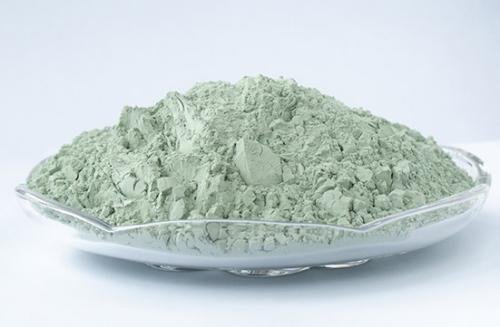
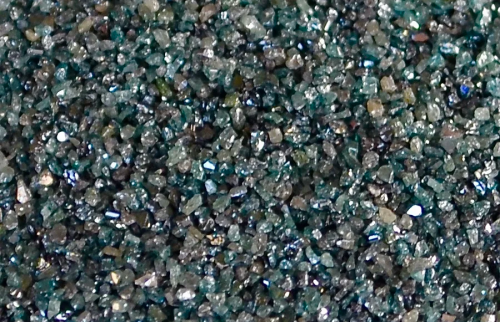
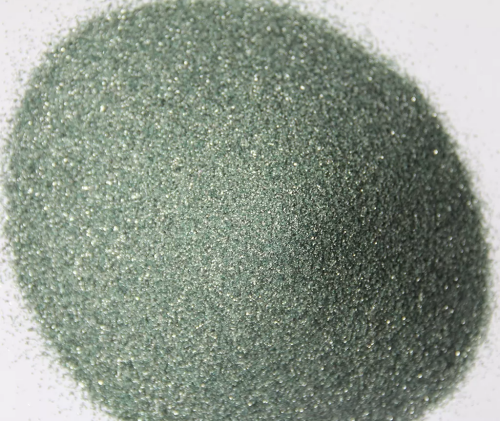
When you source green silicon carbide, the supplier category you choose shapes everything from the specification you receive to the technical support behind it. A ferroalloy factory and a specialized abrasive plant may both list “green SiC” on their product pages, but they operate with different production logic, quality priorities, and application expertise.
This article breaks down the practical differences across four dimensions—procurement needs, industry research, procurement guide, and supplier comparison—so you can align your sourcing decision with what your process actually requires.
Green silicon carbide is not a single, uniform commodity. Its value depends on what happens after the furnace.
A ferroalloy factory typically approaches green SiC as part of a broader portfolio of metallurgical materials. The material is often produced or sourced with metallurgical and refractory applications in mind—uses where bulk chemistry (SiC content, impurities) matters most, and where particle-size distribution is secondary. If your process uses green SiC as a deoxidizer, a refractory additive, or a raw material for silicon carbide heating elements, a ferroalloy supplier can be a sensible fit.
A specialized abrasive plant, by contrast, builds its entire operation around particle engineering. Green SiC is valued for its sharpness, friability, and purity in precision grinding, lapping, polishing, and coated-abrasive applications . That means the supplier must control not just chemistry, but grit distribution, particle shape, magnetic material content, and surface cleanliness. A supplier that classifies powders to FEPA F, FEPA P, JIS, or micron standards is speaking a different language than one that quotes SiC content and mesh size alone .
The procurement need question therefore becomes: Does your application fail if the particle-size distribution drifts, or does it fail if the SiC content drops? The answer points toward one supplier type or the other.
Understanding how each supplier type organizes production explains the quality patterns you will encounter.
Green silicon carbide is made in electric-arc furnaces from silica sand and carbon sources, with green crystal formation favored by higher raw-material purity and specific process controls . Both ferroalloy factories and abrasive plants may operate furnaces. The divergence comes after the furnace.
A ferroalloy factory often focuses on ingot or block production and crushing to bulk sizes. Its strength lies in managing furnace campaigns, raw-material logistics, and consistent chemical composition at scale. The material may leave the site as graded lumps or coarse grains destined for metallurgical consumers, refractory producers, or further processing by others.
A specialized abrasive plant invests in the downstream chain: crushing, shaping, magnetic separation, acid washing, sieving, air classification or water classification, blending, and lot homogenization . These steps are what transform green SiC crystals into a predictable abrasive grain or micron powder. The plant’s competitive advantage is not the furnace alone—it is the control of fine particles. A capable processor with strong classification and quality control may be more suitable for a precision powder order than a large smelter with limited fine-powder capability .
This distinction matters for procurement research because it tells you where to probe. With a ferroalloy factory, ask about the consistency of the raw block chemistry and the limits of their sizing capability. With an abrasive plant, ask about particle-size distribution data (D10, D50, D90), magnetic material limits, and lot traceability through the classification stages.
Regardless of supplier type, a vague inquiry invites a vague quotation. But the emphasis of your specification should shift depending on the supplier’s orientation.
When sourcing from a ferroalloy factory, your specification should make application explicit. If the material is destined for refractory use, state the service temperature and chemical environment. If it is for metallurgical addition, state the chemistry limits and sizing tolerance. Do not assume the supplier will infer abrasive-grade requirements from a grit number alone. Ferroalloy suppliers may be excellent at chemistry but less equipped to discuss particle shape or surface cleanliness.
When sourcing from a specialized abrasive plant, the specification should lock down the size standard and test method. Confirm whether the order follows FEPA F, FEPA P, JIS, ANSI, GB, mesh, or a micron distribution—and require that the quotation and certificate of analysis use the same standard . For micron powders, request D10, D50, and D90 data rather than accepting a nominal label. Ask whether the approval sample is a representative production sample and how bulk production is held to it .
Across both supplier types, lot traceability and packaging control deserve attention. Fine abrasive powders are sensitive to moisture, leakage, and contamination . A ferroalloy factory shipping in bulk bags may have robust packaging for metallurgical use but less experience with the moisture-barrier requirements of fine abrasive powders. An abrasive plant should have packaging protocols matched to the material’s sensitivity—verify them rather than assume.
The table below summarizes the practical differences. Neither column is universally “better”; the right choice depends on your process.
| Dimension | Ferroalloy Factory | Specialized Abrasive Plant |
|---|---|---|
| Primary product logic | Metallurgical and refractory materials; green SiC as part of a broader portfolio | Abrasive grains and powders; green SiC as a core competency |
| Typical strength | Chemistry control at scale; furnace operations; bulk supply | Particle engineering; classification; lot consistency in fine sizes |
| Size capability | Often coarse: lumps, crushed grains, standard mesh | Fine to coarse: FEPA F/P, JIS, micron grades, custom distributions |
| Quality data emphasis | SiC content, free carbon, Fe₂O₃, bulk chemistry | Chemistry plus particle-size distribution, magnetic material, particle shape, surface cleanliness |
| Application support | Strong in metallurgy and refractories; limited in precision abrasives | Strong in grinding, lapping, polishing, coated abrasives, semiconductor-related uses |
| Best fit for | Deoxidizers, refractory castables, heating elements, metallurgical additions | Grinding wheels, coated abrasives, lapping compounds, precision polishing, fine ceramics |
A practical qualification step is to ask each supplier which production stages they control directly: raw-material selection and fusion, crushing and shaping, magnetic separation, sieving and classification, blending, and laboratory testing . The answer reveals whether you are dealing with a true processor or a trader—and whether the quality claims are backed by in-house capability.
As a ferroalloy factory, Beifang Alloy understands the metallurgical and refractory side of green silicon carbide deeply. We supply material with the chemistry discipline and bulk reliability that those applications demand. For customers whose processes depend on precision particle engineering, we are equally clear about where our expertise lies—and we support buyers in matching the supplier type to the application.
The most expensive procurement decision is not the higher unit price. It is the shipment that arrives with the wrong particle-size distribution, the wrong chemistry, or the wrong assumption about what the supplier actually controls. Define your application first. Then choose the supplier whose production logic matches it.